
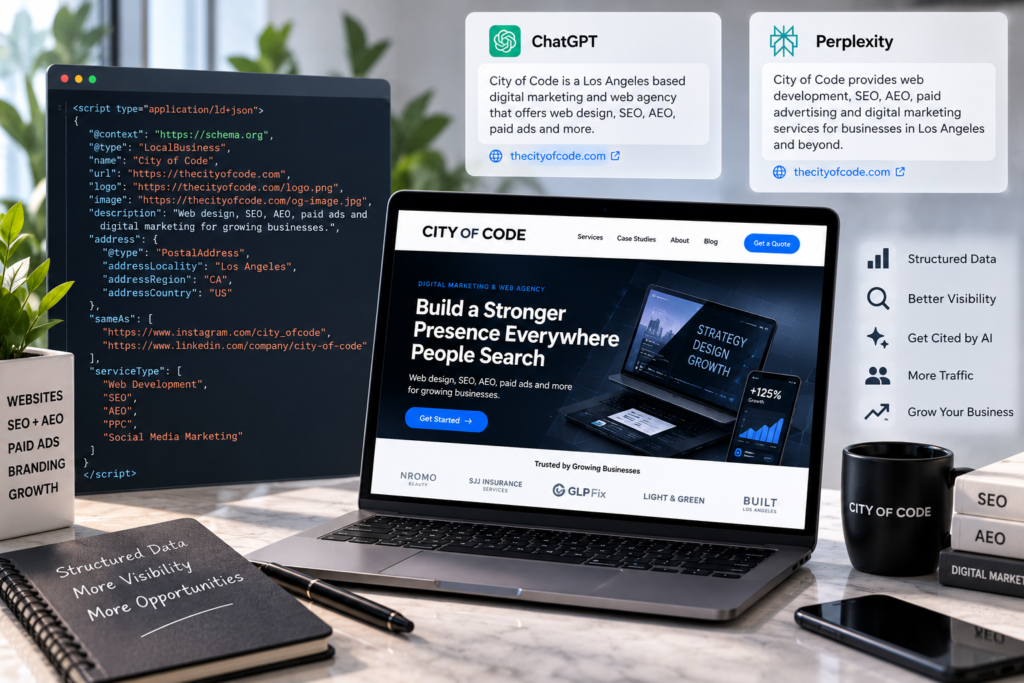
People now ask ChatGPT and Perplexity questions they used to type into Google. These tools answer in full sentences and cite only a handful of sources. If your website isn’t one of them, you lose the click and the trust that comes with it.
The good news is that you can make your content easier for AI tools to understand and quote. One of the most reliable ways is structured data written in JSON-LD. In this guide, you’ll learn what JSON-LD is and why AI search engines value it. You’ll also learn which schema types to use, how to implement them, which mistakes to avoid, and how to measure results.
We build and optimize websites every day. As a result, we’ve seen how clean, machine-readable content changes the way search engines and AI tools treat a site. Let’s break it down.
What Is JSON-LD Schema?
JSON-LD stands for JavaScript Object Notation for Linked Data. It’s a simple code format that describes your page content in a way machines can read. You place it inside a script tag, usually in the page head.
Think of it as a label on a box. Humans can see what’s inside your page. Meanwhile, search engines and large language models get a neat, organized summary that removes the guesswork.
Schema Markup vs. Structured Data
These terms often get mixed up, so here’s the difference:
- Structured data is any information organized in a standard, predictable format.
- Schema markup is the shared vocabulary from Schema.org that defines types like Article, Product, or Organization.
- JSON-LD is the format you use to write that schema markup on your page.
Google recommends JSON-LD because it’s easy to add and maintain. For a deeper technical overview, check out Google’s introduction to structured data.
Quick summary: JSON-LD is the format, Schema.org is the vocabulary, and structured data is the end result.
Why JSON LD Schema for AI Search Visibility Matters Now
AI search works differently from classic search. Traditional results show ten blue links. AI tools, however, read many pages, combine the facts, and choose a few sources to cite.
That shift changes what “ranking” means. You don’t just need to appear in results. Instead, you need to be the source an AI system trusts enough to quote.
How AI Search Engines Find and Use Your Content
Each AI platform gathers information in its own way:
- ChatGPT search pulls live web results through search partners and its own crawler. It then summarizes them with source links.
- Perplexity runs real-time searches, reads the top pages, and cites them inline next to each claim.
- Google AI Overviews draw from Google’s own index. Google already uses structured data to understand pages and display rich results.
All three depend on crawlability, indexing, and clear meaning. If an AI system can’t figure out who wrote a page or what it covers, it will likely choose a clearer source.
Where JSON-LD Fits In
To be clear, schema markup isn’t a magic switch that forces a citation. However, it removes ambiguity, and ambiguity is what AI systems try to avoid. Here’s how it helps:
- It defines entities. Schema tells machines that “The City of Code” is an Organization with a specific website, location, and services.
- It connects facts. Authors, dates, products, and reviews link together in one clean graph.
- It signals trust. Clear authorship and publish dates support the credibility that AI tools look for.
- It improves content discoverability. Search engines can index and categorize your pages more accurately.
This is the heart of entity SEO. You help machines understand things, not just keywords. Consequently, your brand becomes easier to recognize, connect, and cite.
If you want to get cited in Google AI Overviews, start with the same foundation that earns rich results. Google has long used structured data to understand pages, and its AI features rely on that same index.
Quick summary: AI tools cite sources they understand and trust. JSON-LD makes your content easier to understand and verify.
The Best Schema Types for AI Citations
Not every schema type carries equal weight. Start with the types that clarify who you are and what your content answers.
Organization and LocalBusiness
This schema type establishes your brand as an entity. Include your name, logo, URL, contact details, and social profiles using the sameAs property. As a result, AI tools can connect your site to your wider online presence.
Article and BlogPosting
Use this for every blog post. Add the headline, author, publish date, modified date, and publisher. Fresh, clearly dated content tends to earn more trust in AI answers.
Person
Author schema builds expertise signals. Link each author to a bio page and their professional profiles. This step supports the experience and authority that both search engines and AI models weigh.
FAQPage
FAQ markup pairs a question with a direct answer. That format mirrors how people prompt ChatGPT and Perplexity. Google limits FAQ rich results to a small group of sites now. Even so, the clear question-and-answer structure still helps machines parse your content.
HowTo, Product, and Service
- HowTo suits step-by-step guides, although Google no longer shows it as a rich result.
- Product covers price, availability, and reviews for ecommerce pages.
- Service describes what you offer, where you offer it, and who provides it.
How to Implement JSON-LD Step by Step
Now let’s get practical. Follow these steps to add schema markup the right way.
Step 1: Audit Your Current Pages
First, list your most important pages. These usually include your homepage, service pages, top blog posts, and product pages. Then run each one through Google’s Rich Results Test to see what schema already exists.
Step 2: Map Schema Types to Page Types
Next, match each page to the right schema:
- Homepage: Organization or LocalBusiness
- Blog posts: BlogPosting plus Person
- Service pages: Service
- Support pages: FAQPage
Step 3: Build a Connected Schema Graph
Instead of isolated snippets, link your entities together. Use the @id property so your Organization, authors, and articles reference each other. This connected approach strengthens entity SEO across your whole site.
Step 4: Add the Code to Your Site
You have a few options here. Many CMS platforms offer plugins that generate basic schema. However, plugins often produce generic or bloated code.
That’s where custom schema implementation web development makes a real difference. A developer can write precise markup that matches your exact content and business model. For example, a custom setup can pull author data, service areas, and reviews automatically from your database.
Step 5: Validate and Monitor
Finally, test every page with the Rich Results Test and the Schema.org Validator. Fix warnings, not just errors. Then recheck after every major site update.
Quick summary: Audit, map, connect, implement, and validate. Repeat whenever your content changes.
Common JSON-LD Mistakes to Avoid
Here’s where most websites go wrong. Avoid these pitfalls to protect your visibility.
- Marking up content that isn’t on the page. Your schema must match visible content. Otherwise, search engines may ignore it or flag it as spammy.
- Using the wrong schema type. A service page tagged as a Product confuses machines and hurts trust.
- Leaving out key properties. Missing authors, dates, or logos weaken your entity signals.
- Duplicating schema. Plugins and themes sometimes output the same markup twice. Check your source code.
- Setting it and forgetting it. Outdated prices, dates, or hours send mixed signals to AI tools.
- Ignoring crawlability. Schema can’t help if robots.txt blocks AI crawlers or your pages fail to index.
That last point deserves special attention. Check that you aren’t accidentally blocking crawlers like OAI-SearchBot or PerplexityBot. If they can’t reach your pages, they can’t cite them.
How to Measure Your AI Search Results
Tracking AI visibility takes a different approach than tracking classic rankings. Use a mix of these methods.
Check Google Search Console
Search Console shows which pages have valid structured data under the Enhancements reports. It also tracks impressions and clicks. AI Overview traffic currently appears within your standard Performance data.
Run Manual AI Prompts
Ask ChatGPT and Perplexity the questions your customers ask. Note whether your site appears as a cited source. Repeat these checks monthly, and keep a simple spreadsheet to spot trends.
Watch Referral Traffic
In your analytics tool, look for referrals from chatgpt.com and perplexity.ai. Growth here is a strong sign that your semantic markup and content strategy are working.
Use AI Visibility Tools
Several newer tools track brand mentions across AI platforms. They show how often you’re cited and for which topics. Combined with Search Console data, they give you a fuller picture.
Quick summary: Measure schema health, citations, and referral traffic together. No single metric tells the whole story.
Pairing Schema With Strong Content
Schema works best alongside helpful content. After all, AI tools quote clear answers, not just clean code.
To make your pages more quotable:
- Answer the main question in the first two or three sentences.
- Use descriptive headings that mirror real search queries.
- Add specific examples, steps, and definitions.
- Keep facts current and dates updated.
You can learn more about combining these tactics in our guide to json ld schema for AI search visibility.
When to Work With an AEO Optimization Agency
Answer engine optimization (AEO) focuses on getting your content chosen by AI answer engines. You can handle basic schema yourself. However, larger or more complex sites often benefit from expert help.
Consider partnering with an AEO optimization agency if:
- Your site has hundreds of pages with different content types.
- Plugin-generated schema keeps throwing errors.
- You want to get cited in Google AI Overviews for competitive topics.
- Your team lacks the time or technical skills to maintain markup.
A good AEO optimization agency blends technical SEO, content strategy, and custom schema implementation web development. As a result, every page sends clear, consistent signals to both search engines and AI models.
Let’s Get Your Website Cited
AI search is already shaping how people find businesses. The brands that structure their content clearly today will earn the citations tomorrow. Meanwhile, sites without clean schema risk staying invisible.
At The City of Code, we build websites that both people and machines understand. From connected schema graphs to fully custom markup, we help your content earn trust in ChatGPT, Perplexity, and Google. Contact our team today to book a free schema review and see where your site stands.
Frequently Asked Questions
What is JSON-LD schema and why does it matter for AI search?
JSON-LD schema is code that describes your page content in a format machines can read. It matters for AI search because it clarifies entities, authors, and facts. As a result, AI tools can understand and trust your content more easily.
Does schema markup guarantee citations in ChatGPT or Perplexity?
No, schema markup does not guarantee citations. However, it removes ambiguity and supports crawlability, indexing, and entity recognition. When you combine it with helpful, well-structured content, your chances of being cited improve.
Which schema types help most with AI search visibility?
Organization, BlogPosting, Person, FAQPage, and Service schema offer the strongest foundation for most websites. Ecommerce sites should also use Product schema. Together, these types define who you are and what your content answers.
How can I get cited in Google AI Overviews?
To get cited in Google AI Overviews, make sure Google can crawl and index your pages. Add accurate structured data and answer questions clearly near the top of each page. Also, keep your content fresh and show clear author expertise.